Agostinho Neto
Another Day of LifeAgostinho Neto was the leader of the Popular Movement for the Liberation of Angola and, on November 11, 1975, the reader of the declaration proclaiming the People’s Republic of Angola. His central appearance in the account is brief but consequential: at midnight, in a dark and anxious Luanda, his spoken words formally announced a new republic while the war around the city remained unresolved.
Identity and Political Position
Neto led the Popular Movement for the Liberation of Angola, which was backed by the Soviet Union and Cuba. The account places his leadership within a divided struggle: the National Front for the Liberation of Angola, led by Holden Roberto, had Western and Zaïrean backing, while UNITA, led by Jonas Savimbi, was supported by Western powers and South Africa. These rival movements and their foreign support formed the political context for the declaration Neto would make.
The Declaration in Luanda
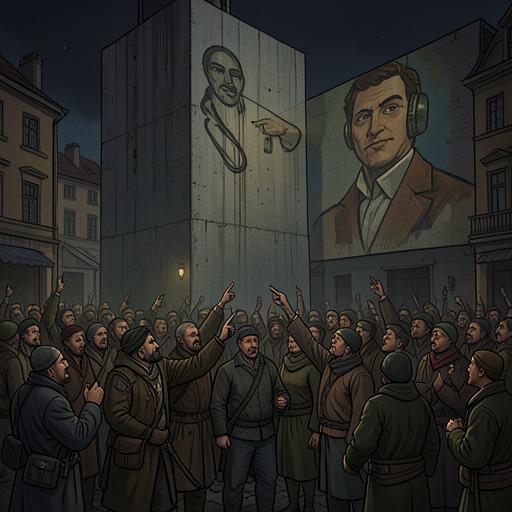
On November 11, the cathedral clock struck twelve as thousands gathered at night in one of Luanda’s squares. People had been urged to avoid large crowds because an attack could turn an assembly into a massacre. In the dark, cloudy conditions, the gathering recalled the secret meetings of the Kimbangists. From the platform, Neto read a text proclaiming the People’s Republic of Angola.
The act was formal, but its delivery was visibly strained. Neto’s voice broke, and he had to stop several times before finishing. The crowd applauded and cheered, though it remained invisible in the darkness. There were no further speeches. The platform lights went out, and people left rather hastily, dispersed into the night.
A Republic Amid Continuing War
The quiet around the square did not mean the fighting had ended. At that moment the artillery on the northern front was silent; then soldiers in town began firing wildly into the air in celebration, and the night filled with chaotic noise. The sequence sets the proclamation against the immediate conditions of war: a moment of political founding, first marked by a fragile silence, was followed by gunfire that was celebratory rather than a sign that violence had passed.
The danger had been palpable in the city before the declaration. During an earlier bombardment, artillery shook Luanda and Holden Roberto announced that he would enter the city that day; his leaflets showed him beneath the claim that God ruled in heaven and Holden on earth. Against this threat, Neto’s proclamation asserted a competing political authority. The account gives no extended description of his policy or subsequent rule, but it makes the declaration’s significance concrete: the republic was announced publicly in a city under threat, by a leader whose voice itself faltered as he gave the new state its name.
Narrative Significance
Neto’s brief reading becomes the hinge between political ceremony and the unsettled reality surrounding it. The crowd’s applause confirms that the declaration was received, while its hurried dispersal and the soldiers’ gunfire deny the scene the calm closure of a settled independence. The contrast between Neto’s broken voice and the declaration’s national scope gives the moment its particular weight: a new political order is proclaimed, but the account leaves it inside the danger and exhaustion of wartime Luanda.